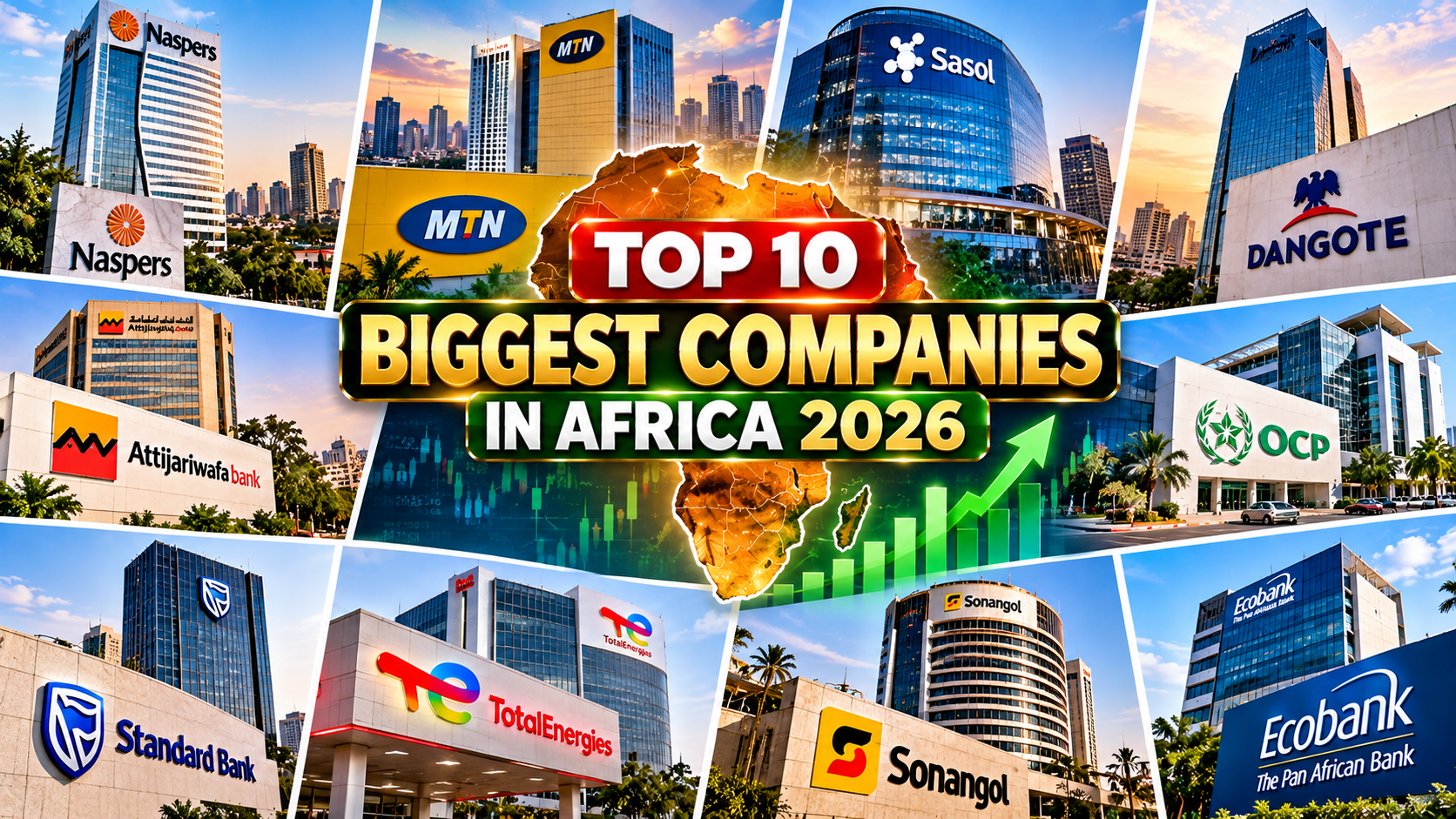
Africa is home to enormous corporations operating across energy, retail, telecommunications, mining, banking, food distribution and manufacturing.
Some generate hundreds of billions of rand in annual sales. Others dominate strategically important industries and operate across dozens of African markets.
But what are the biggest companies in Africa in 2026?
There are several ways to answer that question. Companies can be ranked by market capitalization, revenue, assets, profit or number of employees. Each method produces a different list.
For this TopMost10 ranking, we focus primarily on annual revenue or turnover from the latest full-year financial results available in 2026.
This approach favors the actual scale of a company’s business operations rather than daily movements in its share price.
Important: African companies report in different currencies and use different financial year-ends. Exchange rates also move significantly. Revenue figures should therefore be treated as a measure of approximate operating scale rather than a perfectly synchronized US-dollar league table.
How We Ranked the Biggest Companies in Africa
Our main criteria are:
- Latest reported annual revenue or turnover
- African headquarters or corporate origin
- Scale of operations
- Geographic footprint
- Importance within the company’s industry
We prioritize company annual reports, audited financial statements and official investor-relations releases.
State-owned enterprises are eligible where sufficiently recent financial information is publicly available.
Foreign multinational corporations merely operating in Africa are not treated as African companies. For example, a European or American corporation with African subsidiaries does not qualify simply because it earns revenue on the continent.
10. Dangote Cement
Headquarters: Lagos, Nigeria
Industry: Cement and building materials
Latest annual revenue: Approximately ₦4.31 trillion for FY2025
Dangote Cement is one of Africa’s largest industrial companies and one of the continent’s most recognizable corporate names.
The Nigerian company operates a large cement-production network extending beyond its domestic market into numerous African countries.
Its importance is tied directly to Africa’s urbanization story.
As cities expand and governments invest in roads, housing, commercial buildings and other infrastructure, demand for cement and construction materials can increase substantially.
Dangote Cement reported group revenue of approximately ₦4.31 trillion in 2025, according to the company’s FY2025 results.
Why Dangote Cement Is One of Africa’s Biggest Companies
- Massive Nigerian production base
- Operations across multiple African countries
- Major supplier to Africa’s construction industry
- Approximately 55 million tonnes of annual production capacity
- Part of one of Africa’s most prominent industrial groups
See the latest financial information through Dangote Cement Investor Relations.
9. Vodacom Group
Headquarters: Johannesburg, South Africa
Industry: Telecommunications and financial services
FY2026 revenue: Approximately R167.7 billion
Vodacom has evolved from a traditional mobile operator into a major African digital-services company.
The group operates telecommunications businesses across several African markets and has increasingly expanded into mobile financial services, data and digital products.
For the financial year ended March 2026, Vodacom reported approximately R167.7 billion in group revenue, representing growth from the previous period.
The group also serves hundreds of millions of customers when its wider investments and associated businesses are considered.
Mobile financial services have become particularly important as African telecom operators increasingly compete not only for voice and data customers but also for payments and other financial transactions.
Why Vodacom Is So Important
- Large African mobile subscriber base
- Operations across several major African markets
- Rapidly expanding financial-services business
- Major mobile-data network
- Strategic relationship with Safaricom
View the company’s latest results through Vodacom Investor Relations.
8. MTN Group
Headquarters: Johannesburg, South Africa
Industry: Telecommunications and fintech
FY2025 service revenue: Approximately R218.5 billion
MTN is one of Africa’s largest telecommunications groups and one of the continent’s most geographically extensive consumer businesses.
The company operates across numerous African markets and has built an enormous customer base.
MTN ended 2025 with more than 300 million customers across its markets.
Its business has also expanded beyond conventional telecommunications.
Mobile Money has become an increasingly important part of MTN’s strategy, giving millions of customers access to payments and other financial services through their phones.
MTN reported approximately R218.5 billion in service revenue for 2025.
Why MTN Is One of Africa’s Corporate Giants
- More than 300 million customers
- Operations across numerous African markets
- Large mobile-data business
- Major fintech platform
- Strong presence in Nigeria, Ghana, South Africa and other markets
Readers can examine the underlying figures in MTN Group’s 2025 reporting suite.
7. Bidcorp
Headquarters: Johannesburg, South Africa
Industry: Foodservice distribution
FY2025 revenue: Approximately R235.6 billion
Bid Corporation, better known as Bidcorp, is less famous among ordinary consumers than MTN or Shoprite, but its enormous revenue demonstrates the scale of business-to-business companies operating from Africa.
Bidcorp specializes in foodservice distribution.
It supplies restaurants, hotels, hospitals, catering companies and other foodservice customers across an extensive international network.
For its financial year ended June 2025, Bidcorp reported revenue of approximately R235.6 billion.
Its global footprint makes it unusual among African-headquartered corporations because a substantial part of its business is generated outside the continent.
Why Bidcorp Is So Large
- International foodservice network
- Operations across multiple continents
- Large business-to-business customer base
- Highly diversified geographic revenue
- More than R200 billion in annual revenue
6. Sasol
Headquarters: Johannesburg, South Africa
Industry: Energy and chemicals
FY2025 external turnover: Approximately R249.1 billion
Sasol has been one of Africa’s largest industrial corporations for decades.
The South African company operates across energy, chemicals and related industrial businesses.
Its Secunda operations are particularly important to the company’s production system.
For the financial year ended June 2025, Sasol reported approximately R249.1 billion in external turnover.
Energy and chemical companies can experience substantial changes in annual revenue because their financial results are heavily influenced by oil prices, chemical prices, refining margins, exchange rates and production volumes.
That means Sasol’s position in an annual ranking can change even when the physical scale of its operations remains enormous.
Why Sasol Is One of Africa’s Biggest Industrial Companies
- Large energy operations
- International chemicals business
- Major South African manufacturing assets
- Significant fuel-production capacity
- Global sales footprint
See the latest reports through Sasol’s official financial-results portal.
5. Shoprite Holdings
Headquarters: Cape Town, South Africa
Industry: Retail
FY2026 revenue: Approximately R274.8 billion
Shoprite Holdings is one of Africa’s largest retailers and one of the biggest consumer-facing businesses headquartered on the continent.
The group operates major supermarket brands serving millions of customers.
Its portfolio includes Shoprite, Checkers and other retail businesses.
For the 52 weeks ended June 2026, Shoprite reported approximately R274.8 billion in group revenue from continuing operations.
The scale of the company demonstrates the enormous value of Africa’s consumer-goods market.
Unlike mining or petroleum companies, Shoprite’s revenue is generated through millions of relatively small transactions made by consumers buying food, household goods and other everyday products.
Why Shoprite Is an African Retail Giant
- Enormous supermarket network
- Major South African market share
- Hundreds of billions of rand in annual sales
- Large consumer customer base
- Strong grocery and premium retail brands
Visit Shoprite Holdings for company reports and investor information.
4. Large African Financial and Industrial Groups
Africa’s upper corporate tier becomes more difficult to rank purely from headline revenue because banks, insurers, mining groups and industrial companies use different accounting presentations.
For banks in particular, comparing “revenue” directly with supermarket sales or oil-company turnover can produce misleading conclusions.
Financial institutions such as Standard Bank Group, FirstRand and major North African banks are unquestionably among Africa’s largest corporations when measured by assets, market capitalization and financial scale.
However, TopMost10 does not artificially convert bank assets into sales revenue simply to force them into a revenue ranking.
This methodological distinction is important for keeping the list transparent.
3. Major African Mining Groups
Africa is one of the world’s most important mining regions, and several African-headquartered mining corporations generate enormous annual revenue.
South African-linked mining groups operate in gold, platinum-group metals, iron ore, coal and other commodities.
However, multinational corporate structures can make nationality difficult to define.
Some companies historically associated with South Africa are now legally headquartered or primarily listed outside Africa.
For that reason, this ranking prioritizes companies that can reasonably be described as African-headquartered rather than automatically including every multinational corporation with large African mines.
2. Major African State-Owned Energy Companies
Africa’s state-owned petroleum sector contains some of the continent’s largest enterprises.
Companies in countries including Algeria, Angola and other major hydrocarbon producers can generate revenue on a scale far beyond most consumer-facing African corporations.
However, disclosure standards and publication schedules differ significantly.
TopMost10 therefore uses official published financial statements where possible instead of relying on unsupported online estimates.
1. Sonatrach
Headquarters: Algiers, Algeria
Industry: Oil and gas
Latest consolidated annual revenue used: Approximately DZD 8.64 trillion for 2024
Sonatrach takes the No. 1 position in this ranking as one of Africa’s largest corporations by annual revenue.
The Algerian state-owned energy giant is central to Algeria’s economy and one of the most strategically important energy companies in the Mediterranean region.
Sonatrach operates across exploration, oil and gas production, pipelines, refining, petrochemicals and energy exports.
Its geographic position also gives the company strategic importance because Algeria is a major supplier of natural gas to European markets.
According to Sonatrach’s official 2024 annual report, the consolidated group generated approximately DZD 8.642 trillion in revenue.
The group included more than 100 subsidiaries and investments within its consolidation scope, including international entities.
Why Sonatrach Is Africa’s Corporate Giant
- Enormous oil and natural-gas operations
- Strategic supplier to international energy markets
- Integrated upstream and downstream businesses
- Major pipeline infrastructure
- Trillions of Algerian dinars in annual revenue
- Central role in Algeria’s economy
Readers can verify the figures through Sonatrach’s official annual-report archive.
Summary: Biggest Companies in Africa in 2026
| Position | Company / Group | Country | Industry | Latest Revenue / Turnover Indicator |
|---|---|---|---|---|
| 1 | Sonatrach | Algeria | Oil & Gas | DZD 8.64 trillion (2024) |
| 2 | Large State-Owned Energy Groups | Various | Energy | Varies by reporting period |
| 3 | Major African Mining Groups | Various | Mining | Varies by corporate structure |
| 4 | Large Financial & Industrial Groups | Various | Finance / Industry | Not directly comparable with sales revenue |
| 5 | Shoprite Holdings | South Africa | Retail | R274.8 billion (FY2026) |
| 6 | Sasol | South Africa | Energy & Chemicals | R249.1 billion (FY2025 external turnover) |
| 7 | Bidcorp | South Africa | Foodservice | R235.6 billion (FY2025) |
| 8 | MTN Group | South Africa | Telecommunications | R218.5 billion (FY2025 service revenue) |
| 9 | Vodacom Group | South Africa | Telecommunications | R167.7 billion (FY2026) |
| 10 | Dangote Cement | Nigeria | Cement | ₦4.31 trillion (FY2025) |
Methodology note: The table intentionally preserves reporting currencies instead of presenting false precision through exchange-rate conversions. Financial year-ends also differ. Banks require separate treatment because banking income and assets are not directly comparable with sales revenue at retailers, telecom operators or industrial companies.
Revenue vs Market Capitalization: What’s the Difference?
Revenue and market capitalization measure completely different things.
Revenue measures how much income a company generates through its operations before most expenses are deducted.
Market capitalization is the stock market value of a publicly traded company’s outstanding shares.
A technology or financial company can therefore have a much higher market capitalization than an industrial company that generates considerably more annual revenue.
Why Are So Many of Africa’s Biggest Companies South African?
South Africa has one of the continent’s most developed corporate and capital-market systems.
The Johannesburg Stock Exchange has historically given large South African companies access to deep pools of investment capital, while the country’s relatively sophisticated financial, retail, mining and telecommunications industries produced companies capable of expanding internationally.
This helps explain the presence of Shoprite, Sasol, Bidcorp, MTN and Vodacom among Africa’s corporate giants.
Why Sonatrach Is Different
Sonatrach is different from companies such as Shoprite and MTN because it is state-owned rather than a conventional publicly traded corporation.
Its enormous scale reflects Algeria’s position as a major oil and natural-gas producer.
Energy companies can generate extraordinary revenue because the underlying commodities they sell are traded globally and can be worth billions of dollars.
Where Does Dangote Group Rank?
Dangote Group is one of Africa’s most important privately controlled industrial groups, but ranking an entire private conglomerate using the same methodology as publicly reporting companies can be difficult.
Dangote Cement provides much clearer audited financial information because it is publicly listed.
Other businesses associated with the wider Dangote industrial ecosystem include fertilizer, sugar, salt and the massive Dangote Petroleum Refinery.
The refinery could significantly alter future African corporate revenue rankings as operations scale up.
What Industries Produce Africa’s Biggest Companies?
The continent’s largest corporations are concentrated in several major sectors:
- Oil and gas
- Mining
- Retail
- Telecommunications
- Banking and financial services
- Chemicals
- Food distribution
- Cement and construction materials
Technology companies are growing rapidly but generally remain much smaller by revenue than Africa’s largest energy, retail and telecommunications groups.
Frequently Asked Questions
What is the biggest company in Africa?
Using annual revenue and operating scale, Algeria’s Sonatrach is one of the strongest candidates for Africa’s biggest company. Its 2024 consolidated revenue was approximately DZD 8.64 trillion.
What is the biggest private company in Africa?
The answer depends on whether “private” means privately owned or simply non-governmental. Many of Africa’s largest corporations are publicly listed, while large privately controlled conglomerates disclose less financial information.
What is the biggest retail company in Africa?
Shoprite Holdings is one of Africa’s largest retailers. The group reported approximately R274.8 billion in revenue from continuing operations for its 2026 financial year.
What is the biggest telecommunications company in Africa?
MTN Group and Vodacom are among Africa’s telecommunications giants. MTN surpassed 300 million customers in 2025 and reported R218.5 billion in service revenue.
Is Dangote the biggest company in Africa?
Dangote businesses are among Africa’s largest industrial enterprises, but Dangote Cement alone does not exceed every African company by revenue. Sonatrach, large South African corporations and other major groups can be larger depending on the metric used.
Which African country has the most large companies?
South Africa has an unusually large concentration of major publicly listed African corporations, particularly in retail, telecommunications, finance, mining and industry.
Are banks included in rankings of Africa’s biggest companies?
Banks can be included, but comparing bank assets or interest income directly with supermarket or industrial sales can be misleading. A separate ranking of Africa’s largest banks by assets is more meaningful.
Explore More African Business Rankings
Discover more continental rankings in the TopMost10 Africa Rankings section.
For company, entrepreneur and industry rankings, visit our Business & Companies section.
You can also explore wealth-related rankings through Wealth & Net Worth.
Final Thoughts
Africa’s largest companies demonstrate just how diverse the continent’s corporate economy has become.
Sonatrach represents the enormous scale of North Africa’s energy sector. Shoprite demonstrates the power of African consumer spending, while MTN and Vodacom show how telecommunications and mobile financial services have become critical infrastructure.
Sasol remains an industrial heavyweight, Bidcorp demonstrates the global reach possible for an African-headquartered company, and Dangote Cement reflects the scale of infrastructure development occurring across the continent.
The ranking will continue to change.
New energy projects, expanding telecom networks, African industrialization and the growth of businesses such as the Dangote refinery could reshape the list substantially over the next several years.
For that reason, TopMost10 will continue updating this ranking as companies release new audited annual results.